

Masanobu Shinjo occupies an important place in the modern history of Okinawan Goju-ryu. He was not a student of Goju-ryu founder Chojun Miyagi, who died in 1953. Instead, Shinjo trained in the postwar generation that inherited, interpreted, and preserved the art through Miyagi’s students.
At Seikichi Toguchi’s Shoreikan dojo, Shinjo became a highly capable instructor. Frank Van Lenten recalled first meeting him there in 1963. He wrote that Shinjo was practically teaching many of the classes when Toguchi traveled between Okinawa and Japan, and called him “an excellent teacher even then.”
In 1963 Shinjo established Shobukan in Okinawa. According to Van Lenten’s account, the school became known for hard, traditional training and for its focus on kata. The work was not detached from teaching: Shinjo trained with his students, including in demanding drills such as sen-zuki, or one thousand punches.
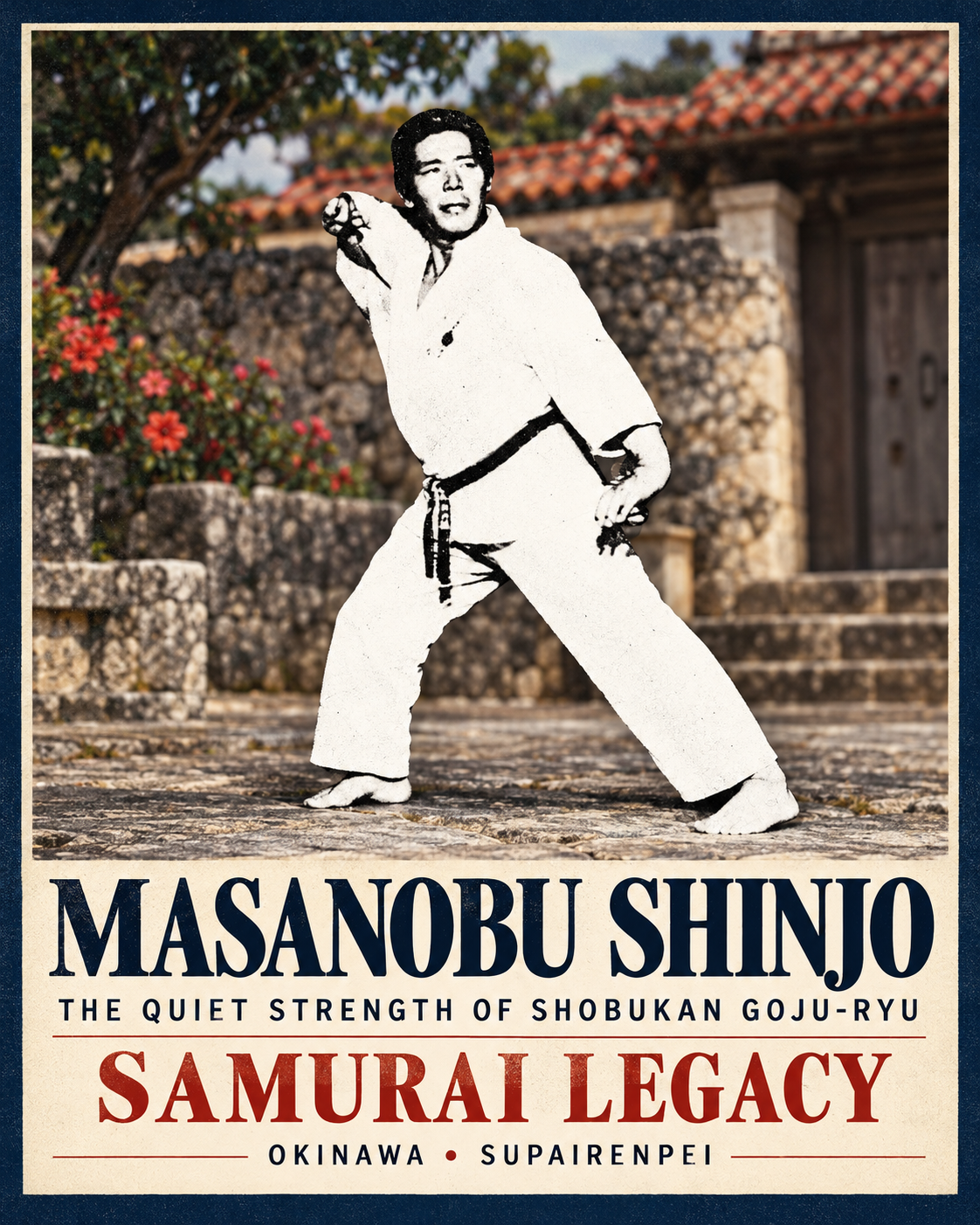
Shinjo’s Goju-ryu was not simply a display of athletic power. Kata, breathing, body conditioning, and patient repetition were central. The surviving photograph used in this post shows him demonstrating Supairenpei, one of Goju-ryu’s advanced classical kata. Van Lenten’s book identifies Shinjo as a Hanshi and describes Supairenpei as a form reserved for advanced teachers in Okinawan practice.
According to Van Lenten, Meitoku Yagi appointed Shinjo President of the All-Okinawa Gojukai in 1983. Contemporary Shobukan sources use All-Okinawa Karate-Do Federation wording; this article does not treat those organization names as interchangeable.
Van Lenten’s later work in the United States forms one branch of that legacy, but it should not eclipse Shinjo himself. Van Lenten remained direct and candid about the influence: even after their formal Shobukan affiliation ended, he still wrote that Shinjo was the greatest karate instructor under whom he had trained.
Masanobu Shinjo died in 1993. His legacy continues through Shobukan and through the students, instructors, and families who continue to treat karate as a discipline shaped by repetition, example, and character.