
The Three Unifiers of Japan · Part 1
Before Japan could be united, its balance of power had to change. Oda Nobunaga helped set that change in motion.
A defining moment
Oda Nobunaga (1534–1582) rose during Japan’s age of warring states. At Nagashino in 1575, his army and Tokugawa Ieyasu’s forces defeated Takeda Katsuyori. Matchlock firearms played an important role. The victory is a useful place to consider how leadership, preparation and weapons could reshape a contest for power.
His record also demands that we face its human cost. Nobunaga’s destruction of the Enryaku-ji monastery complex in 1571 caused devastating loss of life. In 1582, Akechi Mitsuhide turned against him at Honno-ji, where Nobunaga died. His ambitions remained unfinished.
A reflection
Adapt when circumstances demand it. But before seeking power, consider what you mean to protect—and what you must never become.
This is our editorial reflection, not a quotation from Nobunaga. We can study a person’s adaptability without treating his victories as an excuse for cruelty.
The armor and crest
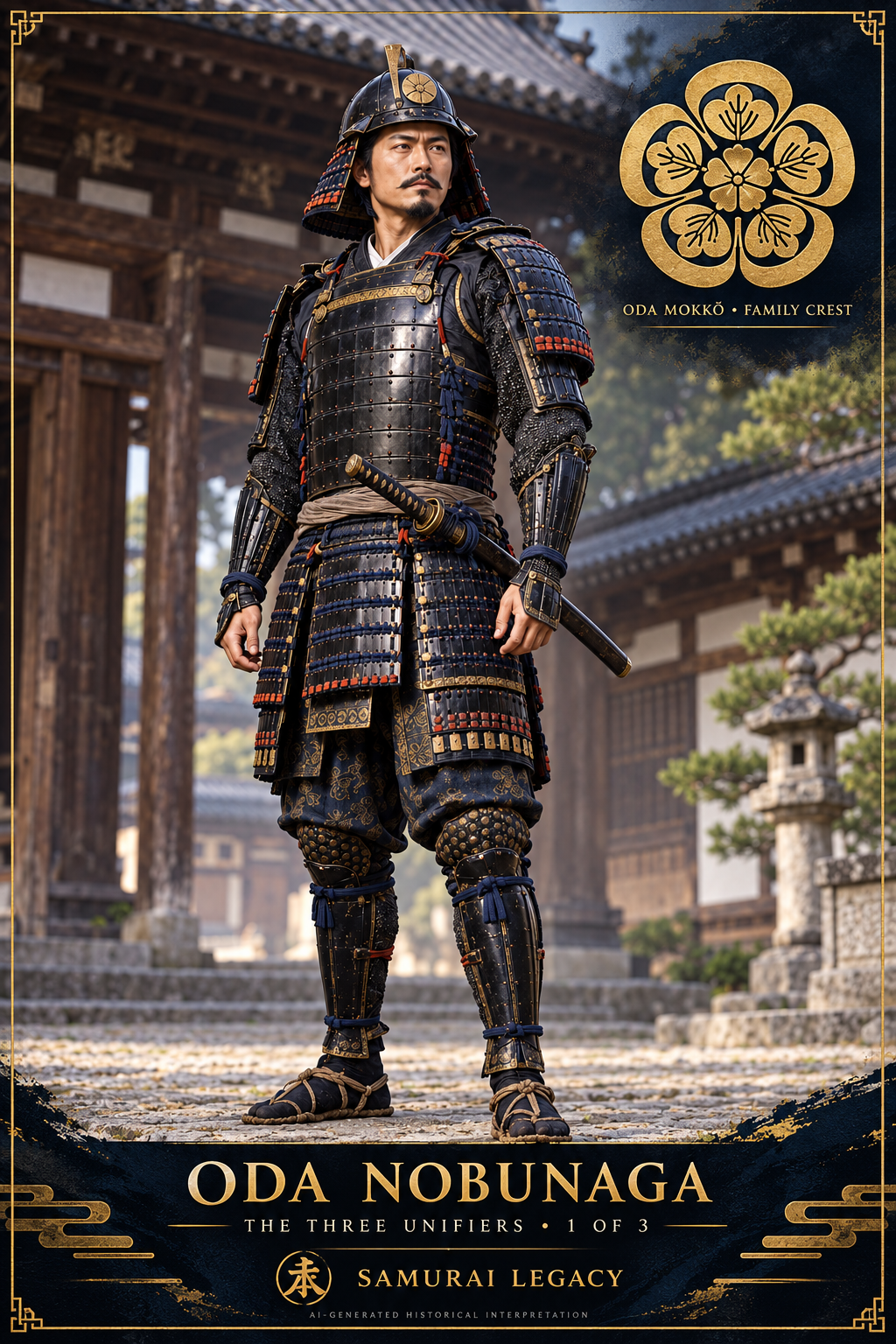
The armor is presented as an artistic reconstruction, not an authenticated personal ensemble. Dark torso plates contrast with indigo lacing, reddish accents and gold detailing. Layered shoulder guards shape the silhouette, while overlapping helmet guards protect the neck. These visual choices give the reconstruction its character; they do not establish what Nobunaga personally wore.
Armor rewards close attention. How the torso closes, how its plates connect, and how the shoulder defenses move are distinct questions. A dramatic silhouette alone cannot identify an armor’s construction. The Met’s sixteenth-century dō-maru, object 2018.833.4, offers a documented comparison: lamellar construction, right-side fastening and a multisection skirt. Its green, white and vermillion lacing differs from the proposed dark palette. It is a comparison, not evidence that Nobunaga wore the illustrated suit.
The Oda mokkō supplies a documented family connection. The Met describes a five-petal Oda emblem on a surcoat said to have been given to Hideyoshi by Nobunaga. That qualified attribution should remain qualified. The emblem identifies a family association; it does not make an illustrated suit Nobunaga’s own or establish that this was his only crest. The large upper-right emblem in this illustration is a stylized interpretation inspired by the Oda mokkō. Its internal pattern differs from the museum example. The smaller helmet ornament is also interpretive and has not been authenticated as an Oda crest.
Explore Samurai Legacy and The American Samurai.